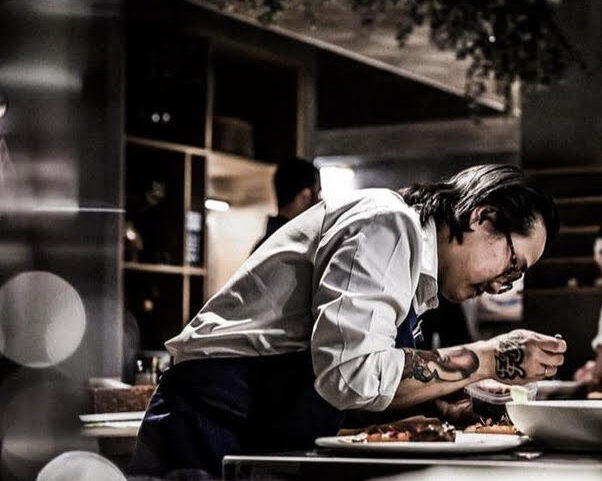
Colby Rasavong has proven himself to be a spectacularly multilayered onion of a chef, the type that hits the hot oil with a splash and immediately blooms — sharp, sweet, savory, and soulful. Every layer of creation reveals something deeper and more profound, clearly illustrating his culinary pedigree. The more that you deconstruct and understand these layers, the more apparent his genius becomes.
At first glance, Bad Idea, the Nashville wine bar and eatery Rasavong helmed, appears to be the embodiment of entropy, or loosely controlled chaos at best. Natural wine. Loud flavors. Lao sauces colliding with French techniques. Cheeseburger pithiviers wrapped in laminated pastry. Scallop-stuffed crepes bathed in funky fermented drizzle. Crispy nam khao croquettes exploding with herbs, acid, and crunch all at the same time. But underneath all of that swagger is structural precision gleaned from his experiences and layered seamlessly around his Lao core.
Rasavong is a first-generation Laotian-American, and even when his food drifts into French techniques or Southern sourcing, its soul remains unapologetically Lao. Sticky rice. Fermented funk. Fish sauce. Lime. Chili. Herbs. Umami. Food designed to wake up every taste bud abruptly, like a flavor cardioversion for your tongue.
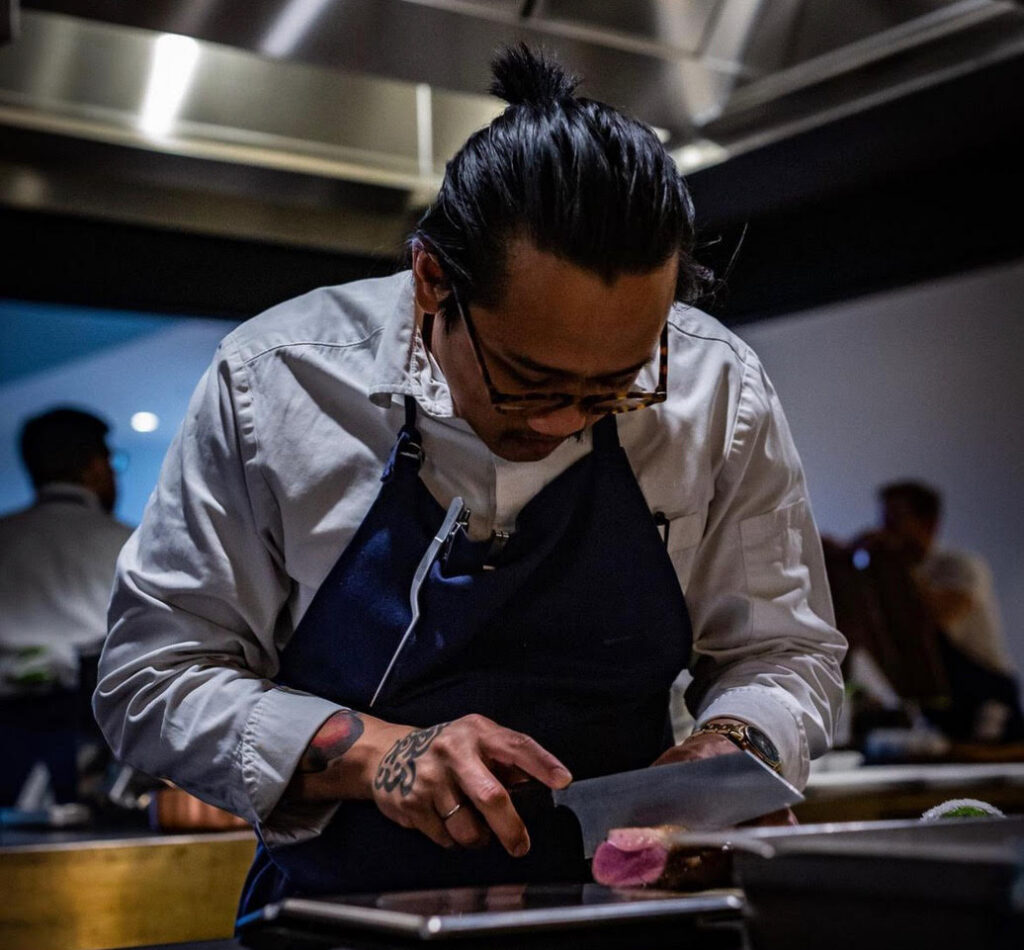
“I missed the food I grew up with, but I didn’t want to prepare strictly Lao dishes,” Chef told me. On the path to Bad Idea becoming one of the hottest restaurants in America, Rasavong had a long climb through some of the most influential kitchens in modern Southern cooking. That climb formed his culinary DNA.
His early foundation started with culinary vocational training in Murfreesboro, Tennessee before he moved on to Nashville kitchens. One of his first major restaurant roles was garde manger at Kayne Prime, located on Nashville’s prestigious M Street. That position matters more than most people think. The cold station in a serious restaurant teaches finesse and restraint instead of brute force: knife precision, acid balance, preservation, visual discipline, and timing. It taught him how to use tiny adjustments of individual components as leverage to change an entire plate. Then came his triple stent in Sean Brock’s world at McCrady’s, Husk, and Audrey.
At McCrady’s in Charleston, Rasavong absorbed the obsessive discipline that single-handedly repositioned modern Southern cuisine in America. Precision plating. Hyper-seasonality. Fermentation. Ingredient worship. McCrady’s was where Southern fare stopped being bourgeois comfort food and began being as revered as European fine dining.
Then, his time at Husk deepened the lesson. Husk’s philosophy is legendary: “If it doesn’t come from the South, it’s not coming through the door.” There Rasavong learned how to build menus around regional ingredients instead of importing luxury ones. Heirloom grains. Southern vegetables. Whole-animal butchery. Seasonal sourcing. That influence still resonates through his cooking today.
Next was Audrey. This Appalachian restaurant was deeply personal to Chef Brock. As Rasavong served there as chef de cuisine, his food became something bigger than a tasty meal. Audrey taught him about memory, culture, storytelling, preservation, and the use of food to conjure emotion. Appalachian foodways filtered through modern techniques. It’s where Rasavong learned that cuisine could communicate identity.
Then he was on to New York. At Benelux in Brooklyn he learned craveability—how to make chef-driven food feel loose, social, addictive, and alive. Beer culture. Oyster bar energy. Fat-acid balance. Big flavor without losing structure. Next, at Little King in Brooklyn, the pendulum swung toward restraint. European bistro philosophy. Wine-forward cooking. Minimalist plating. French and Italian backbone. Precision instead of clutter. No unnecessary garnishes. No screaming for attention. Just pure technique doing its job beneath the plate.
This esoteric combination of experiences is exactly why the James beard-nominated Bad Idea menu hit so explosively. Rasavong wasn’t cooking garden variety fusion food. He was cooking autobiography.
For example, the nam khao croquettes, made from fried crispy rice, herbs, fermented pork, lime juice, and fish sauce, teaches a definitive masterclass in the five tastes. Sweetness from fried garlic and rice. Salinity from fish sauce. Acid from lime. Bitterness from herbs. And then umami, that deep mouth-filling savoriness that lingers like a deeply satisfying bass note from a Baritone sax.
In the south, umami is what puts the soul into soul food, but it is traditionally built through smoked meats, ham hocks, gravy, and slow-cooked pork fat. Rasavong conjures his umami from the ocean. Fermented fish. Seafood stock. Fish sauce. Funky Lao fermentations. This savoriness doesn’t punch through like barbecue. It explodes in layers like a deeply satisfying fourth of July fireworks extravaganza.
Rasavong’s cheeseburger pithivier also illustrates the onion analogy. French pastry technique wrapped around an aggressively American comfort-food core, all electrified with Lao acid, fermentation, and spice. Familiar but ineffable. Refined but reckless.
Rasavong believes that Nashville is currently standing at a crossroads hungrily awaiting its next culinary epiphany, and he plans to be the person who delivers it. “Nashville is going through some great trends right now and it’s very exciting,” he said. “But it almost feels replicated and derivative, like a plateau. I left Bad Idea to create Nashville’s next echelon of unique dishes and I’m very excited about it”
Stepping away from a venture this revolutionary illustrates his resolve to evolve. Evidently for Rasavong, his onion still has many more layers left to be discovered.
AUTHOR

Brad Blankenship is a retired integrative medicine doctor who has resided in Nashville for over 50 years. He, along with his wife Lulu Burns-Keller travel the US in search of new flavors. Together, they write, photograph and review for Beyondish in the Nashville area and beyond.

NEXT ON THE DISH