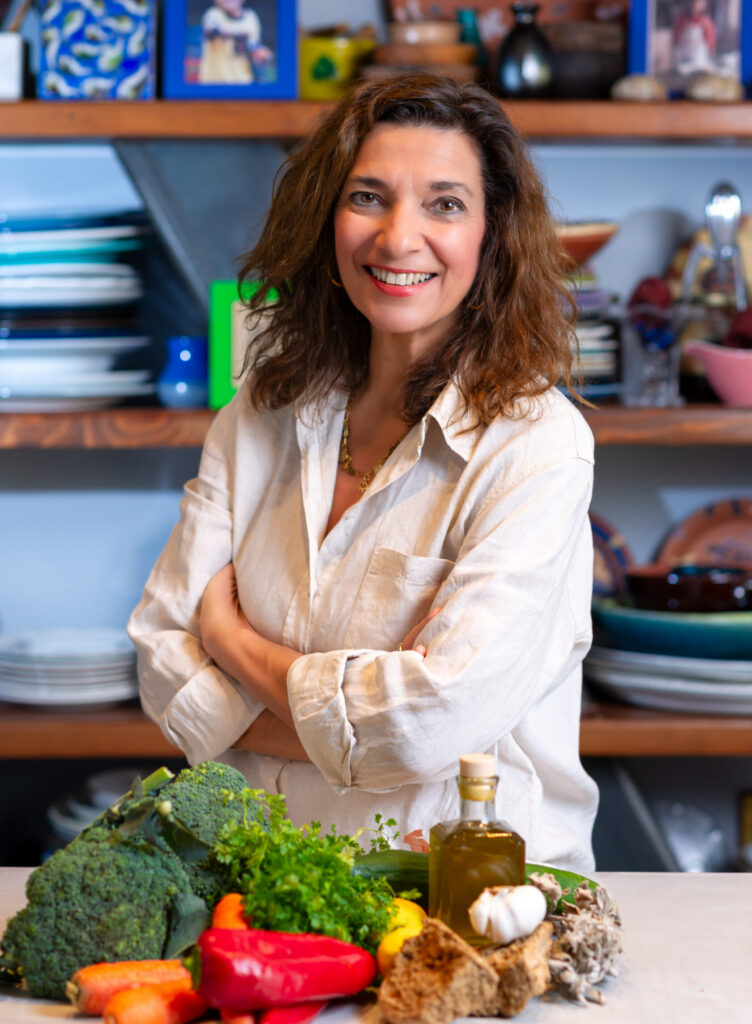
A few years ago, a man walked into Diane Kochilas’ cooking school on Ikaria, Greece with his wife. He owned a ranch in Montana and had spent most of his adult life eating meat three times a day. By the end of the week, he told her, sheepishly, that he had never expected plant-based food to taste like this. That it could be, actually, deeply satisfying.
That moment stuck with Kochilas. It became the impetus for her second Ikaria book, and it captures, better than any tagline could, what she has spent decades trying to do: close the distance between the Greek table and everyone else’s.
Kochilas is the host and co-creator of the PBS series My Greek Table and the author of ten cookbooks, including the New York Times bestseller The Ikaria Way. She is also the founder of The Glorious Greek Kitchen, her cooking school on Ikaria, where that rancher had his revelation.
For years, Kochilas has been dismantling the same assumption: Ikarians eat meat, goat, chicken, pork, and always have. “But these things have to be seen in context,” she says. “Industrial meat is way less prevalent. A lot of people who live there year-round have their own animals.”
A generation ago, she explains, meat was for Sunday lunch, for celebrations. What never changed is the relationship with the seasons. “We know the seasons for produce,” she says, “and anticipating that makes them all the tastier.” Her translation of the entire Ikarian philosophy for an American kitchen comes down to five words: “Don’t eat strawberries in January.”
Seasonality, at least, can be taught. The rest is harder. “We definitely don’t eat with the same slow pace here in the U.S.,” she says. “There is always such a bombardment of information, mostly confusing, and a way of life that is rushed and goal-oriented and materialistically focused, that to adopt a truly mindful approach to our table habits is at best difficult.” And then there is the question of community, the kind that spans generations, that was never organized but simply evolved. “Community in Ikaria and other villages and small towns in Greece is something that spans generations and is interwoven with family ties. It’s not created and imposed. That’s a hard model to replicate.”
Which makes what happens in American Greek restaurants even more frustrating. The Blue Zones obsession, the post-pandemic longevity craze, none of it has changed what ends up on the menu. “The conversation post-pandemic, re: Greek food, hasn’t really evolved,” she says. “There’s a formula that works, the grilled fish and familiar dishes.” Ask about the surge in regional Greek cooking and the answer is swift. “I am not seeing that surge. Where?”
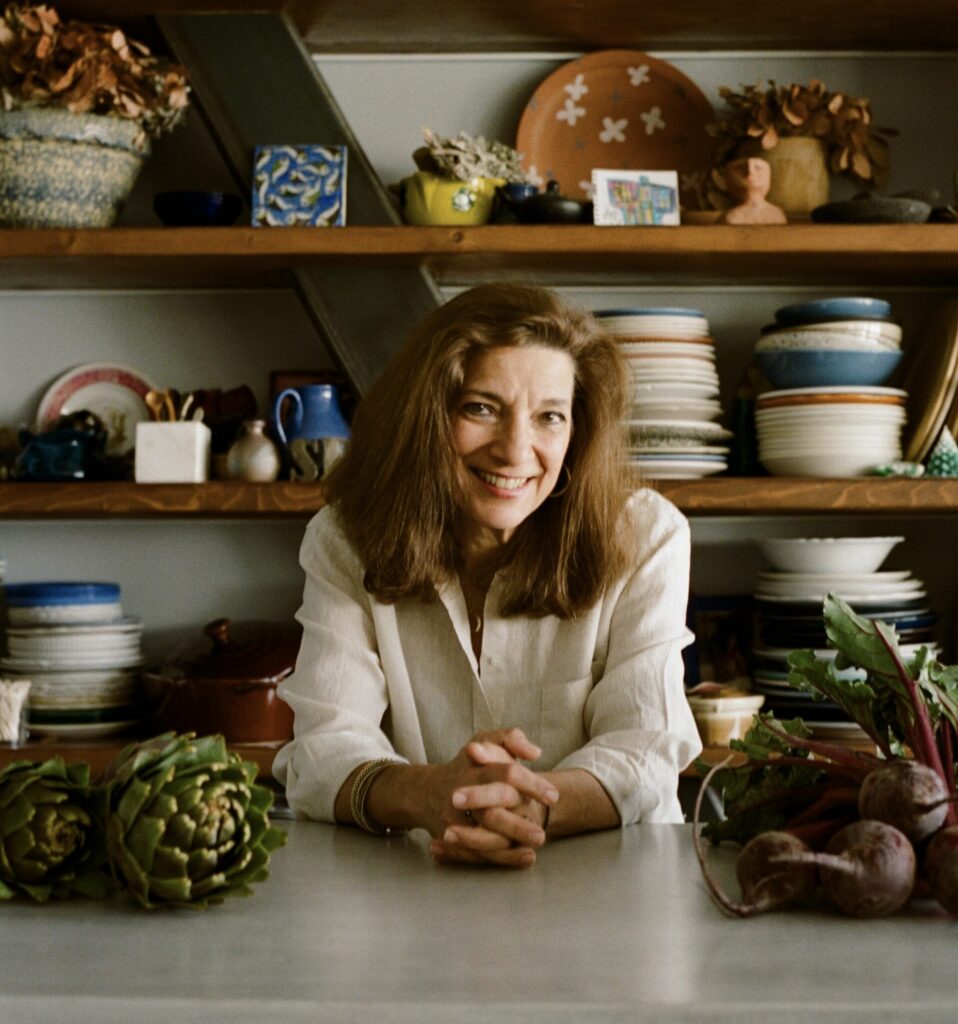
Photo: Loulia Koval
In New York City, where Kochilas spends most of her time when stateside, Greek restaurants still run on the same rotation. Fava. Roasted eggplant. Spinach pie. Horta. Giant beans. “Most of the new Greek restaurants in NY have almost nothing plant-based culled from the enormous range of plant-based dishes in Greece on their menus,” she says. “I’d love to see a Greek vegetarian restaurant somewhere.” When she consulted for Molyvos in New York and added an Ikaria Longevity Greens Pie to the menu, “it sold like crazy.” The appetite is there. Something else isn’t.
Athens tells a different story. Kochilas has lived there for 35 years and watched the city cycle through economic collapse, social upheaval, and culinary reinvention. Her newest book, Athens: Food, Stories, Love, emerged from all of those years. “The Athens book was simmering on a back burner for a long time,” she says. “I bore witness to several distinct cycles of change, social change, economic change. All that mirrored in the city’s food culture.” What surprised her most was who is now driving it. “My kids’ Athens is a different city from mine. It’s their generation that is now leaving its own mark, the internet generation, with way fewer emotional ties to tradition than my generation has.”
Through all of those cycles, one thing held. “The quality of food here, the caliber of raw ingredients, is superior to anything I’ve ever tasted anywhere,” she says. “Even the ‘worst’ Greek produce is better than 95 percent of the stuff we find in high-end markets in the U.S.”
That intimacy with the land is also what makes the book personal — “about me making sense of my own life and decision to move there 35 years ago.” She is a journalist by trade and will tell you the research is as much fun as the cooking, if not more. Every chapter carries that. “Almost every aspect of life in Greece has long roots and a story,” she says, including the Greek salad, whose modern form was invented by taverna owners in the Plaka in the 1960s as a way to sidestep government price controls.
The through-line across all ten books, she says, is simpler than any trend. According to Kochilas, the sheer continuity of ingredients that are basic to the cuisine – olives, olive oil, herbs, fish, honey, nuts, greens, figs – trump any dietary fads and advice. This is a time-tested, over millennia, way of eating. “It’s food for everyman, food for survival that happens to be delicious.”
Hippocrates said it first, twenty-five centuries ago: let food be thy medicine, and medicine be thy food. The Greeks never forgot.
AUTHOR

I am Theodora Tsevas, a Greek-American writer and photographer with a deep appreciation for Mediterranean culture and more. My work revolves around exploring new destinations, savoring local cuisine, and conveying these experiences through my writing and photography.
NEXT ON THE DISH