Last year, more than 122 million people worldwide were forcibly displaced, according to the UN Refugee Agency. Many were forced to leave their home countries and start over — securing work, navigating new languages, and building stability within unfamiliar systems. Since 1975, the United States has resettled more than three million refugees. Organizations like Emma’s Torch step in to support this transition. Their work centers on food — a shared foundation that crosses cultures and borders.
Founded in New York, the nonprofit trains refugees, asylees, and survivors of human trafficking for careers in food and hospitality through culinary education and training. Emma’s Torch has worked with individuals from more than 65 countries and built a comprehensive training-to-employment model designed to move students from the classroom into the workforce. “We believe refugee resettlement is not an act of charity, but a chance to invest in people who bring resilience, talent, and a drive to build something better,” founder Kerry Brodie tells Beyondish. “This is our version of the American Dream: not one reserved for a few, but one built by many, together.”
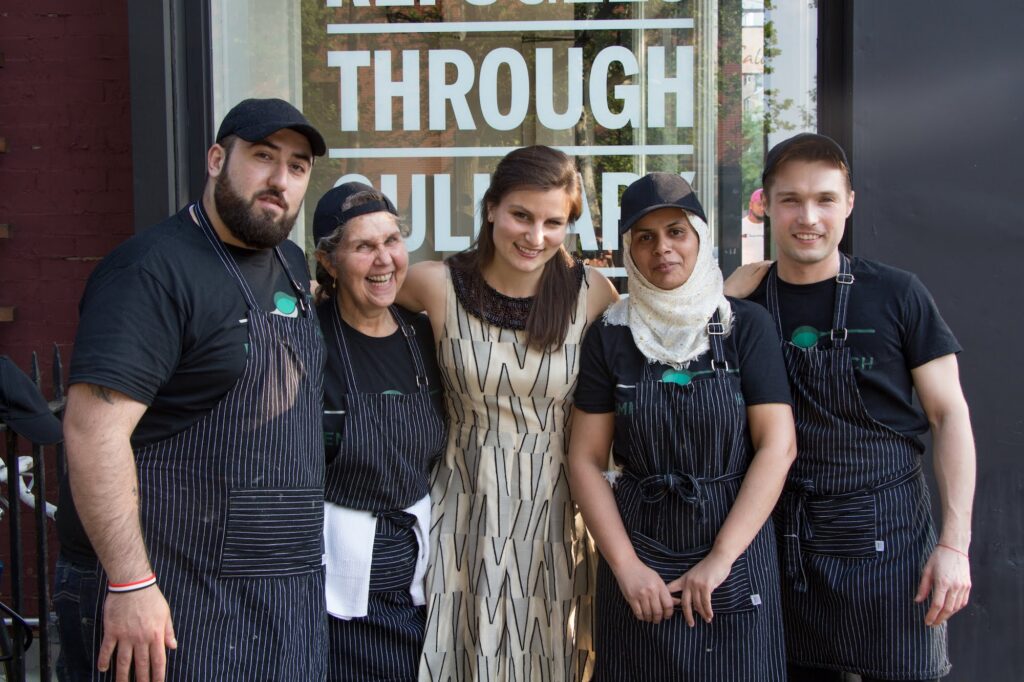
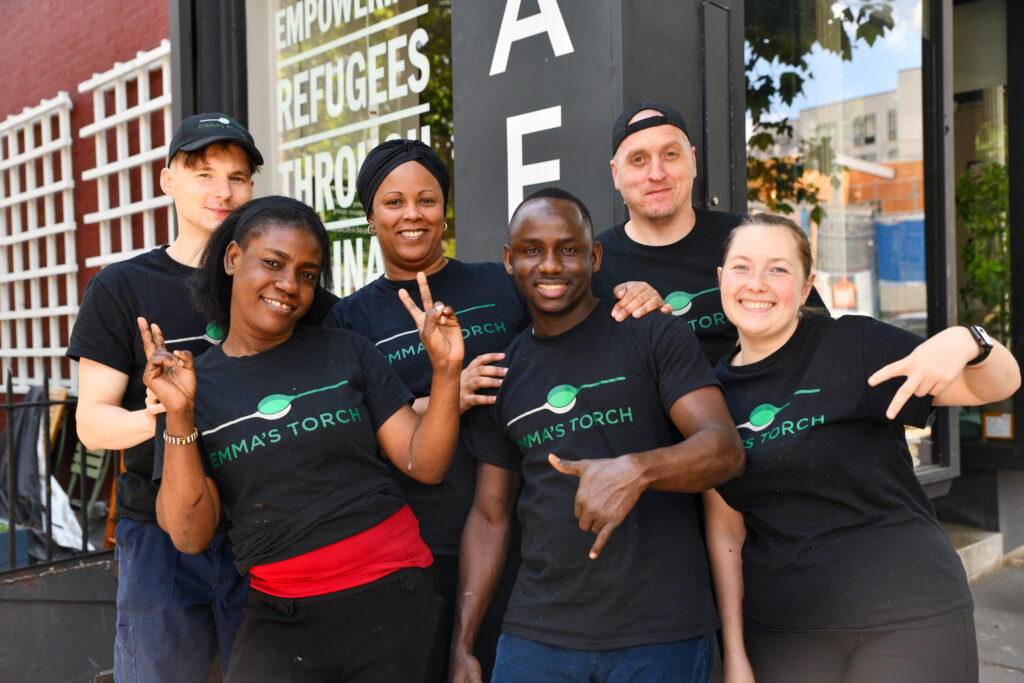
Founder Kerry Brodie, center.
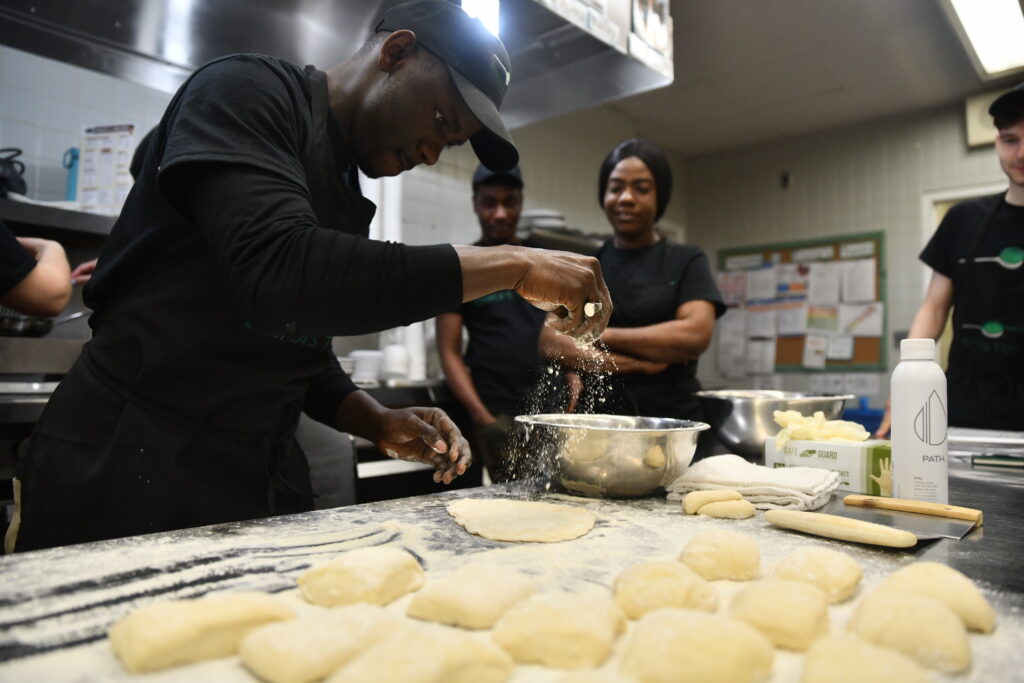
Brodie sees cooking as a way to create shared understanding despite differences. “Across cultures, languages, and experiences, preparing and sharing a meal creates immediate connection. Food is woven throughout the entire day at Emma’s Torch,” she says, pointing to the daily family style meal students and staff share. “It isn’t just nourishment: it’s a moment of community.” Learning to cook professionally also offers students a way to share their heritage. At graduation, each student prepares a dish representing where they come from — a reminder that their heritage is an asset, not something to leave behind.
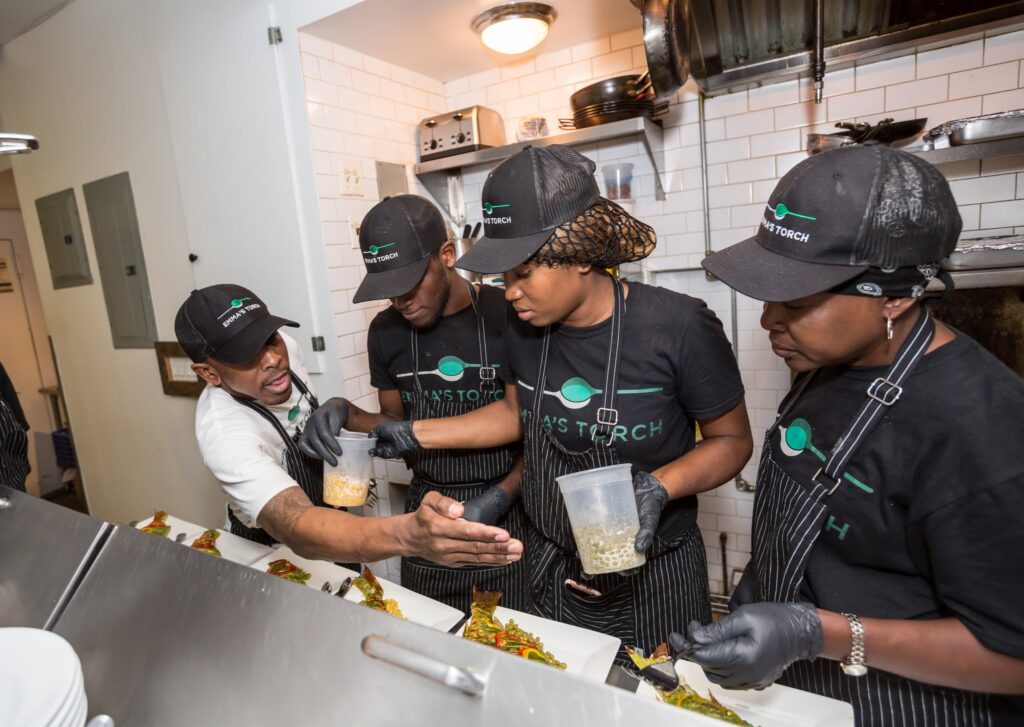
The organization operates an 11-week paid apprenticeship combining hands-on kitchen training with English-language instruction, job readiness workshops, and individualized career support. Students, ranging in age from 18 to 65, rotate through front- and back-of-house roles in cafes, catering kitchens, and classroom settings, mastering sanitation standards, knife skills, communication, and professional technique. Graduates leave with job placement support and a clear path into the food and beverage industry. According to their 2024 Annual Report, Emma’s Torch has surpassed its 500th student enrollment.
One such student, Naseema, offers a clear example of the program’s impact. She left Afghanistan in search of a better life for her six children and enrolled as one of its first students. Brodie says she had a clear determination to rebuild her life. Years later, her son Muhammad also enrolled in the program. “Two generations of students from Naseema’s family are now thriving in their newfound careers. I think this is an amazing example of not only the success of our program, but the ripple effects of how empowering individuals can uplift entire families and communities,” said Brodie.
In many ways, Naseema’s experience echoes the foundation where the program first took root. Long shaped by immigration and defined by its food culture, New York offered both industry infrastructure and public support. “From the beginning, we were embraced by a community that believes in creating opportunity and great food,” Brodie says. She adds that it “understands that a kitchen can be a classroom, a launchpad, and a home,” and that the organization is proud to be part of “this tradition of big dreams and new beginnings.” That connection to migration is embedded in the organization’s very name.
The nonprofit pays homage to Emma Lazarus, the 19th-century New York poet whose sonnet “The New Colossus” helped recast the Statue of Liberty as a symbol of welcome, its lines appearing on a plaque at the monument’s pedestal. The organization began in 2016 as a Brooklyn catering venture and pop-up and evolved into a flagship cafe in Carroll Gardens and a second inside the Brooklyn Public Library. During the pandemic, Emma’s Torch pivoted to remote support for students. In 2024, they expanded to Washington, D.C. Though that location has since closed, they have shifted focus to a new Culinary Training Center and Cafe in nearby Silver Spring, Maryland, set to open this year.
That development project drew industry attention, including grant support from renowned chef José Andrés. Brodie says his public backing has been instrumental to the nonprofit’s growth. “Partnering with someone who uses food not just to feed, but to heal and uplift aligns perfectly with our mission,” she says. “José brings heart and a deep belief in the power of food to change lives — and that’s exactly what we aim to do at Emma’s Torch every day,” says Brodie. Andrés, in writing about the organization on his Substack, highlighted how culinary training gives new Americans practical skills and pathways into stable work, underscoring why he chose to support the organization.
In today’s political climate, programs like Emma’s Torch take on added significance. Despite divisive headlines, Brodie points to those that continue to show support. “As policies grow colder, we’ve seen communities grow warmer,” she says. “We firmly believe in traditional American values like opportunity, dignity, and neighborliness, and we know they are alive and well in the communities we serve.” She strongly believes in the model’s impact. In the decade since its founding, graduates have added more than $34 million in increased wages to local economies.
As Emma’s Torch grows, the focus remains on the same steady commitment to practical training and long-term opportunity. Brodie speaks proudly of what the staff and students have built together. “We are reminded every day that the power of community can outshine the weaponization of policy. Together we can continue to build a more welcoming and hopeful future.”
AUTHOR
Becca Knowlton is an internationally published writer and journalist covering the human interest stories connecting us all. Her bylines appear in Eater, Voquent (UK), Oregon ArtsWatch, Willamette Living, Beyondish, and San Diego Reader. She writes about exploring and celebrating our shared humanity through food, travel, and art. She is currently based in the Pacific Northwest.


NEXT ON THE DISH