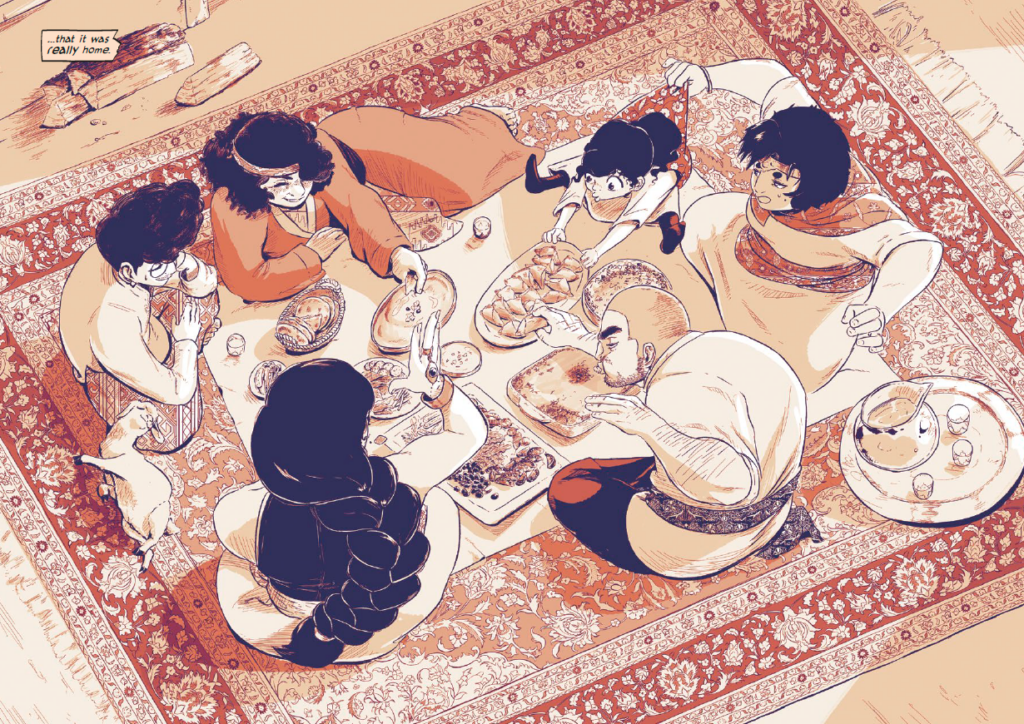
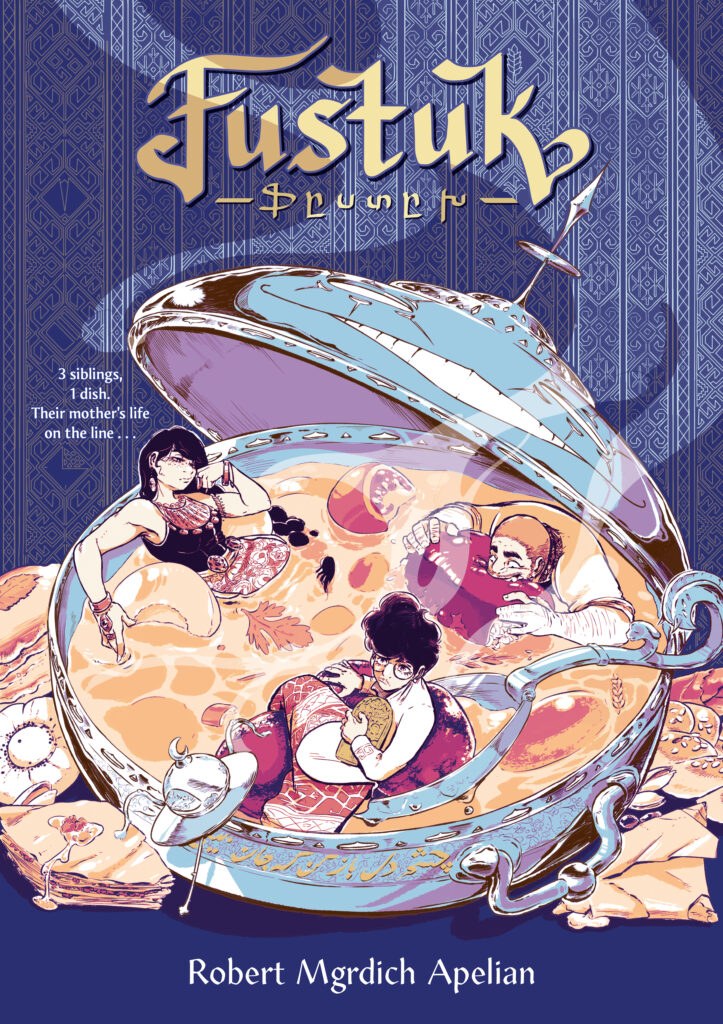
Family. Food. Cultural pride. Love. Sacrifice. On January 20, 2026, readers step into a fantastical version of the Persian Empire through Fustuk: A Graphic Novel by Armenian American author-illustrator Robert Mgrdich Apelian. To save their mother, who is suffering from a chronic illness, a family of chefs makes a deal with a sinister spirit. This deal not only challenges the family’s bonds and threatens to tear them apart, but also takes three siblings on a journey predating their existence. Apelian shares with Beyondish the behind-the-scenes of making this almost nine-year dream a reality, the importance of sharing stories about Middle Eastern joy and magic, and why food plays such an essential part in his debut novel.
First, I want to congratulate you on your debut graphic novel. Can you introduce yourself to our readers and share your journey to becoming an author-illustrator?
I’m Rob, an Armenian-American author-illustrator, manga nerd, and cooking enthusiast. I always read comics and manga as a kid, and drew my own characters and worlds since as far back as I can remember. After taking a break from creative work through high school and post-college (to focus on things that would “make money,” ugh), I ended up burning out and returning to the drawing and writing I used to love. So in 2017, armed with a phone full of notes and unrealistic standards, I started drawing every day, taking classes, and making comics with friends until my skill was high enough, actually, to get a book published. The idea that became Fustuk was basically there from the beginning of that journey, and I feel unbelievably lucky that it’s actually real now.
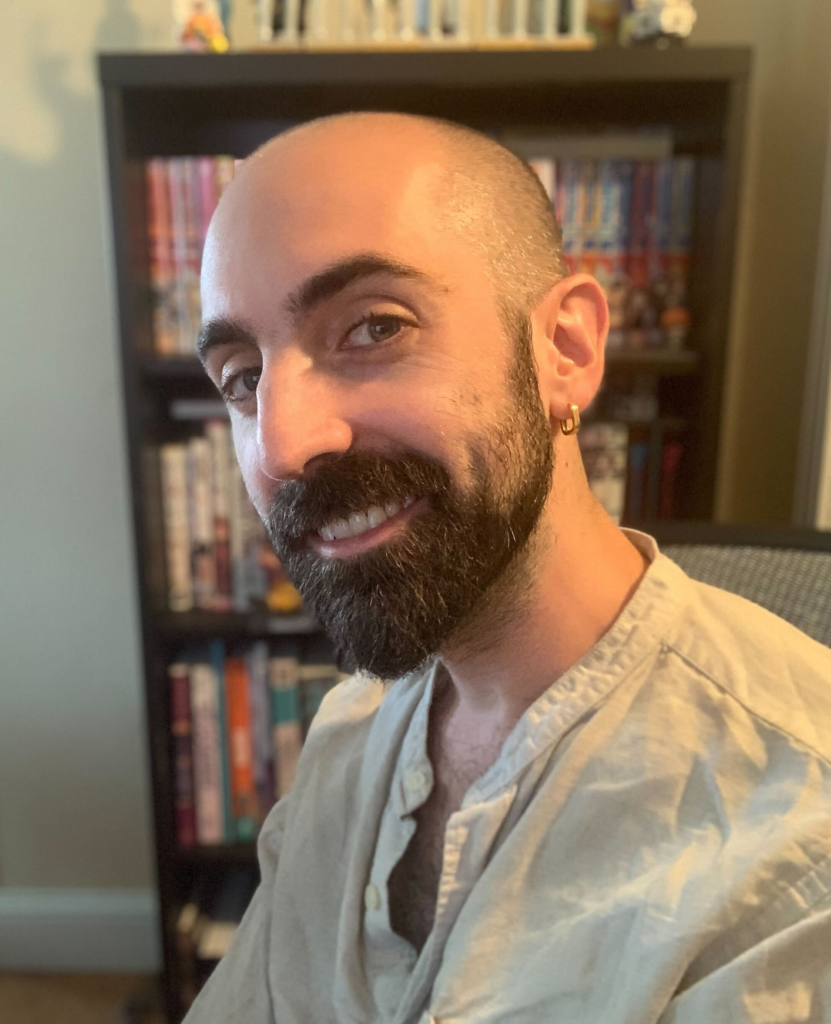
Fustuk author Robert Mgrdich Apelian.
This was such a bold idea for a debut novel. What was your thought process going into writing this book? How did you come up with the ideas?
The world came first, actually, with the story idea developing in parallel. I knew, as an Arab-Armenian, that there is so much to love in Middle Eastern history and culture that rarely gets shown in the West from an inside perspective. Most depictions are either tragic or extremely exoticized, and I think that has a real impact on the way people in the West view the Middle East to this day. It’s probably naïve, but I hope that worlds like this can help people appreciate that there’s more to the region than religious conflict and genies.
How long did it take from start to finish?
The story itself started with the core themes and the conflict between the siblings about their relationships with their heritage. As a reader, my favorite thing in the world is when you have a mysterious plot with lots of threads that all come together in a huge, emotional, intricate climax. So I started with that and pulled it all through there. With something as short as a graphic novel, you have to work really hard to get an emotional reaction from your readers, and so I did a lot to make sure I could make that happen. All in all, I started noodling on the idea in 2017, but formal work started when I got the deal with my publisher in 2021. So it took four years of constant work.
Why did you decide to name the book Fustuk?
I wish I had a more fun answer for this, but that was originally just the family’s last name. The world in my book was a bit farther from the real one at first, and I had this whole system of cultures with different food themes, but ended up scrapping that. But still, I kept Fustuk (meaning pistachio) in their last name as Fustukian, and kept all the pistachio theming I hid in various clothing patterns, rugs, and panel borders. As for why pistachios of all foods, I heavily associate them with Armenian-ness, despite them actually being most tied to Persian culture. And I love them! I also think there’s something metaphorically valuable about the way you have to crack open their shells to get to their meat.
The way you weave family, food, honor, and cultural pride is so beautifully done. Pulling from your own background, being a second-generation Armenian American, what theme particularly stands out to you?
Honestly, these themes are all already woven together in my mind. My relationship with my culture is so intrinsically linked to my family, and my family so linked to our food, that it’s hard for me to pick one. But I think there’s something special about how effective food is as a cultural ambassador and the way it spreads across place and time, mixing with the ingredients and people it touches while still maintaining its identity. I was always anxious about how assimilated I felt. I feared that I wouldn’t be able to pass on the culture I grew up with, so it was actually cuisine that helped me model my own path to maintaining my culture and figuring out what being Armenian really meant to me –but also to see what it meant to the people in my family from different generations.
I love that each chapter is named after a Middle Eastern Dish. Do you have a favorite from the ones featured throughout Fustuk?
All the Hye dishes in the book were basically just me picking all my favorites from childhood. If I had to pick just one from the chapter titles, I’d say probably Sarma, the wrapped grape leaf dish. The grape leaf gives such a unique flavor, but it’s so umami, hearty, satisfying and cozy. Many of the other dishes were picked to fit the plot and themes, showcasing a lot of the uniqueness of Persian cuisine (when compared to Arabic-Armenian cuisine) or, conversely, to show their similarities. I won’t name it to prevent spoilers, but the big final dish in chapter 8 was one that I found out about only when doing research for this book, and it’s become something I cook all the time now. Definitely my new favorite.
Any dishes you love that are not featured but wish you had the space to include?
Oh, so many. I tried to at least draw every dish somewhere in the background, but I do wish I could’ve devoted more time to things like lahmajun (“Armenian/Turkish pizza”), or bread-making in general. I’m also a huge coffee nerd these days, so I hope someday to write more about that.
It’s clear how much research went into creating Fustuk’s fantastical version of the Persian Empire. You worked with anthropologist and food expert Amir Sayadabdi. What was that experience like?
I’m so grateful to Penguin Random House for connecting us! I thought it was a long shot when I suggested it, but Amir was so excited to help me with the book and develop the world. It was really difficult to find good information in English about what a kitchen would look like in the medieval Persian empire, or what cooking in a more rural location like the family’s house would entail, and he was able to illuminate so much of that while still giving me room to be creative and fantastical.
Food symbolizes many things throughout Fustuk. It’s healing, sacred and magical. I could go on. So, what does food mean to you?
To this day, when I get together with my family, the main things we do are cook and eat. Like you said, food is a unique art form in that it’s not just beauty and art, it’s also necessary and sometimes it’s about being nutritional and healing. One food that pops up a couple of times in the book is “madzoon abour”–a kind of yogurt soup which was always a dish I loved when I was sick. It’s a really tedious dish to make. You have to stir it continuously for like 30 minutes so the yogurt doesn’t curdle, which to me is such an emotional component of the dish. That this thing you’re making to take care of someone is so difficult and laborious, it really clearly represents your love.
A large part of this book feels like a love letter to your family.
A lot of Armenian dishes are that way, actually, involving wrapping, rolling, stuffing–they’re well suited to making in big groups, becoming communal activities, showing the love everyone involved has for each other. Cooking is an art form and it’s healthy. I really think it’s one of the most important things about the human experience. I can’t sing its praises enough.
I grew up in fandom culture, and you’re a manga lover. You know that even when we finish something, we want to explore more. Can you tell us a couple of cookbooks, poems, or dishes we can seek out after finishing this book?
I’m so honored to hear that you got that feeling of “oooh, I want more of this” after finishing Fustuk – that’s such a high compliment! If you’re a history nerd, I totally recommend checking out the 16th-century Persian cookbook I referenced – A Persian Cookbook: The Manual by Bavarchi. In general, I highly recommend finding Persian or Armenian restaurants anywhere you can near you. If you aren’t familiar with them, there’s a whole world of amazing food waiting for you , especially Persian Khoreshes (stews), Tahdig (“burnt rice”), and Armenian Sarma, Dolma, and Kufte/Kibbe. If you can’t find them, I eventually plan to upload recipes for every chapter-title dish on my website (robertapelian.com), though as of writing, there’s nothing up yet.
This is the worst question to ask, especially since this is so new. As a reader, though, I have to know. Is there currently something in the works to expand this into a series? And visually, I’d love to see it on the screen.
You and me both, friend. Having a Fustuk animated film is quite literally my biggest dream. I can’t say exactly what’s coming next, but I intend to continue telling stories in this same historical fantasy world–different places and characters, but all connected. There are a lot of little elements in the background of Fustuk that hint at the larger world, and I plan on keeping those promises in the future!
AUTHOR

Allanah Dykes is a freelance writer whose niche is home decor and food, but she has written in almost every field from mental health to political op-eds. Her favorite pastimes are listening to Biggie and Bach and enjoying New York Italian ices and slices

NEXT ON THE DISH